What Is a Trading Signal? A Plain-English Guide
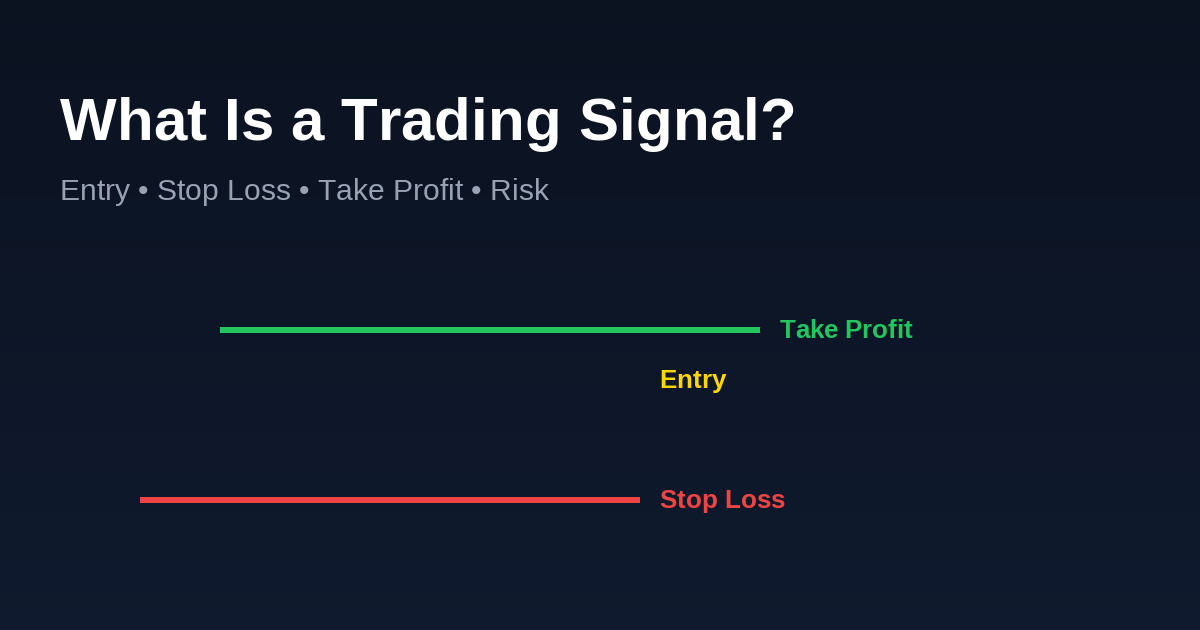
A trading signal is a ready-made trade idea that tells you which market to trade, whether to buy or sell, where to enter, where to place a stop loss and where to take profit. Signals are produced by human analysts or automated systems and delivered through channels such as Telegram, apps or email, and you decide whether to place the trade and how much to risk. A signal is a suggestion, not a guarantee, and you remain responsible for every trade you take.
Key takeaways
- A complete signal includes the instrument, direction, entry, stop loss and one or more take-profit levels.
- Signals come from human analysts, algorithms and expert advisors (EAs), or a combination of both.
- You can follow signals manually or through copy trading, which places trades in your account automatically.
- Free and paid signals both exist; transparency, consistency and risk discipline matter more than price.
- Judge a provider by its verifiable track record, independent reviews and realistic claims, and treat any guaranteed-profit promise as a red flag.
- Start on a demo account, then risk only a small percentage per trade when you go live.
What a trading signal is
A trading signal condenses market analysis into a short set of instructions. Instead of spending hours on charts, you receive the conclusion: for example, "buy gold between these two prices, exit if it falls to this level, take profit at these targets". The analysis behind it may be technical (chart patterns, support and resistance, trend structure), fundamental (interest rates, inflation, economic data), or both.
Signals are popular in gold (XAUUSD) and forex because these markets trade almost around the clock on weekdays and can move quickly, which makes it hard for part-time traders to watch every setup. You still decide whether a trade suits your account, whether you can enter at a reasonable price, and how much you are willing to lose.
Who produces trading signals
Human analysts
Many providers employ analysts who study charts and the economic calendar, then publish trade ideas. Their strength is context: a person can skip a setup ahead of major news or send an update when conditions change. The weakness is that quality depends on the people involved.
Algorithms and expert advisors
Other signals come from rules-based software, called expert advisors (EAs) in MetaTrader. Algorithms apply the same rules every time without emotion, but can struggle when conditions change in ways their rules were not built for. Some providers combine the two, using software to scan for setups and analysts to filter them.
Manual trading vs copy trading
With manual signals, you read the alert and place the order yourself in your trading platform. You keep full control and learn as you go, but you need to be available and act quickly while the entry is still valid.
With copy trading, a service links your account to the provider's and replicates their trades automatically, usually scaled to your account size. It saves time but reduces your control, and your results can differ from the provider's because of spreads, slippage and execution delays. Either way, confirm that stop losses carry over and that position sizes match your own risk limits.
The components of a trading signal
| Component | Example | Purpose |
|---|---|---|
| Instrument | XAUUSD, EURUSD | Which market to trade |
| Direction | BUY or SELL | Whether you expect price to rise or fall |
| Entry | A single price or a price zone | Where to open the trade |
| Order type | Market or pending (limit or stop) | Whether to enter now or wait for a level |
| Stop loss | A fixed price level | Caps the loss if the idea is wrong |
| Take profit | TP1, TP2, TP3 | Where to close all or part of the trade |
| Notes | Risk guidance, news warnings | Context and management instructions |
A signal missing any of these, especially the stop loss, is incomplete. Our guide on how to read gold signals walks through a full illustrative example, including how to work out risk-to-reward from the levels.
Types of trading signals
By timeframe
- Scalp signals target small moves and may last only minutes. They need fast execution and tight spreads, so trading costs weigh more heavily.
- Intraday signals open and close within the same trading day, typically lasting from under an hour to several hours.
- Swing signals may be held for several days to capture larger moves, which means wider stops and exposure to overnight and weekend price gaps.
By analysis method
- Technical signals are based on price action, indicators, and support and resistance levels.
- Fundamental signals are driven by economic data, central-bank decisions or geopolitical events.
Many signals blend the two, for instance a technical setup that is only taken if the news calendar is clear. Gold and currency pairs also behave differently in volatility and session timing; our comparison of gold signals vs forex signals explains how.
How signals are delivered
- Telegram is widely used because messages arrive instantly on phone and desktop and a single channel can serve a large audience.
- Provider apps may add push notifications, trade history and charts.
- Email is slower, so it suits swing signals better than scalps.
- Copy-trading platforms connect directly to your trading account and place trades for you.
Turn notifications on so you see signals while the entry is still valid, and join channels only through the provider's official links.
Free vs paid signals
Free signals let you see a provider's style and communication before spending money. Paid services usually offer more signals, detail or support. Price alone says nothing about quality.
When comparing free and paid options, look at:
- How many signals are sent and at what times of day
- Whether every signal includes a stop loss from the start
- Whether results are published in full, including losses
- Whether follow-up management updates are provided
- Billing, cancellation and refund terms
How to evaluate a signal provider honestly
A transparent track record
Look for a history that includes losing trades, not just screenshots of winners, and covers a long period in different market conditions.
Third-party reviews
Independent platforms such as Myfxbook let users post feedback about signal providers. Read both positive and negative reviews and look for patterns in communication, consistency and how losing periods are handled.
A stop loss on every signal
If a provider regularly posts trades without a stop loss, or adds one only after the trade has moved, that is a serious warning sign about its attitude to risk.
Realistic claims
Every approach has losing periods. Providers that discuss drawdowns openly tend to be more credible than those that advertise only profits.
Clear refund and cancellation terms
Before paying, know exactly what is included, how billing works and how to cancel.
Regulatory status
Signal providers are not brokers, and most are not licensed investment advisors. They do not hold your money or execute trades on your behalf, and their signals are general information rather than personal advice. Your funds sit with your broker, so choose a broker that is properly regulated where you live.
Red flags and common scams
- Promises of guaranteed profits, fixed monthly returns or no-loss strategies
- Pressure tactics such as countdown timers and limited-time offers on joining fees
- Requests to send money to an "account manager" who will trade for you
- Signals without stop losses, or losing signals that are quietly deleted
- Results shown only as screenshots, with no way to verify them
- Unsolicited direct messages from accounts impersonating well-known channels
- Requests for your trading account password or login details
Impersonation is common on Telegram, where fake accounts copy the names and logos of genuine channels. Never send funds or login details to anyone who contacts you privately.
How to start using trading signals safely
- Learn the basics first. Understand entries, stop losses, take profits and lot sizes before you trade real money. The beginner's guide to gold signals is a good starting point.
- Follow on a demo account. Trade the signals with virtual funds for several weeks to learn the format and timing.
- Set a small fixed risk per trade. A common guideline is 0.5% to 1% of the account per trade, sized from the stop-loss distance. Our XAUUSD risk management guide explains the calculation.
- Go live small. Use minimum lot sizes until your process is consistent.
- Keep a journal. Record each signal, your entry and exit, and any differences from the provider's levels.
- Review regularly. After a meaningful number of trades, compare your results with the provider's.
An example provider: United Kings
United Kings is a gold (XAUUSD) and forex signal provider established in 2010. It delivers signals on Telegram, with more than 300,000 members in its free channel and more than 13,000 VIP traders. VIP members receive up to 10 signals a day, each with entry, stop loss and take-profit levels. United Kings is a signal provider, not a broker or investment advisor, and third-party user reviews are available on Myfxbook. To weigh it against alternatives, see our best gold signals roundup, or review the plan details on the pricing page.
FAQ
Are trading signals worth it?
They can help if you lack time for analysis or want to learn from structured trade ideas, but no service removes risk. Their value depends on the provider's transparency and your own execution, so test on a demo account first.
Are free trading signals reliable?
Some come from established providers as a preview of a paid service; others come from anonymous accounts with no verifiable record. Judge them by the same standards as paid signals: a stop loss on every trade, honest reporting of losses and independent reviews.
Is a signal provider the same as a broker?
No. A broker holds your funds, executes your trades and should be regulated where you live. A signal provider only publishes trade ideas and does not hold your money or place trades for you.
Can trading signals guarantee profits?
No. Every trading approach has losing trades and losing periods, and past performance does not guarantee future results. Treat any provider that promises guaranteed returns as a red flag.
Trading gold and forex on margin carries a high level of risk and may not be suitable for everyone. Past performance does not guarantee future results. This article is educational content, not financial advice.
Get United Kings gold signals
Entry, stop loss and take-profit levels on every XAUUSD signal, delivered on Telegram.
Related articles
- How to Choose a Forex Signals Provider (Checklist)
A practical checklist for choosing a forex signals provider: what to verify, red flags to avoid, how to test signals cheaply, and what to ask before you pay.
- Beginner’s Guide to Gold Signals (XAUUSD)
New to gold (XAUUSD) trading? What gold signals are, how they work, and how to follow United Kings signals step by step with sensible risk.
- United Kings Gold Signals Review (2026)
United Kings gold signals review for 2026: what VIP includes, signal format, Telegram delivery, pricing, refund window, pros, limitations and who it suits.