XAUUSD Risk Management: Position Sizing & Stops
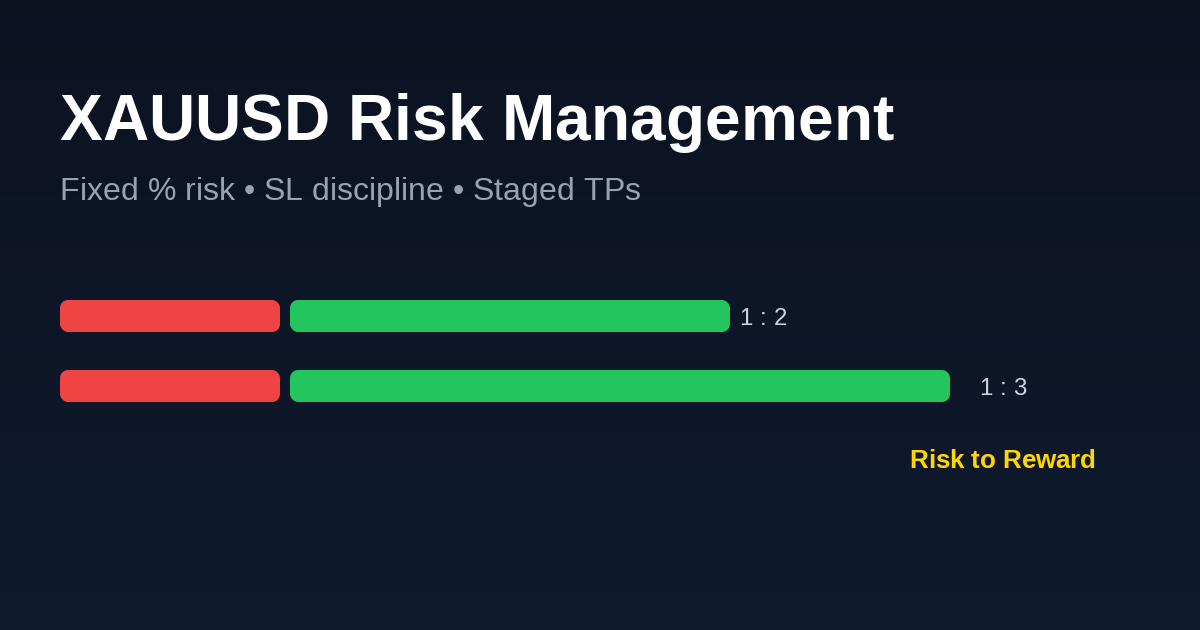
Good XAUUSD risk management comes down to three habits: risk a small, fixed percentage of your account on every trade, calculate your position size from the distance to a stop loss you never widen, and reduce exposure as the trade moves in your favour. The core formula is position size = (account balance × risk %) ÷ (stop distance in dollars × ounces per lot). Everything else, from scaling out to cutting size around news, builds on that.
Key takeaways
- Decide your risk per trade before anything else; many traders choose between 0.5% and 1% of their balance.
- Position size = account balance × risk % ÷ (stop distance in dollars × ounces per lot). Brokers define XAUUSD lot size and "pips" differently, so check your broker's contract specification.
- Place the stop where your trade idea is proven wrong, then size the position to fit it. Never widen a stop to avoid a loss.
- Scaling out at TP1, TP2 and TP3 and moving the stop to breakeven reduces risk once a trade is working.
- Reduce size or stand aside around CPI, non-farm payrolls and FOMC decisions.
- A trade journal with a weekly review turns these rules into habits.
Why risk management matters more in gold
Gold moves in large dollar increments and is usually traded on margin, so leverage turns ordinary swings into big account swings. Every strategy has losing streaks, and risk management makes sure a normal one is survivable.
The arithmetic is simple. Ten consecutive losses at 1% each leave about 90% of your account; at 5% each, about 60%. Recovering from a 40% drawdown requires a gain of roughly 67%.
Step 1: Choose a fixed risk per trade
Pick a percentage of your balance and risk that amount on every trade. Many traders use 0.5% to 1%; a lower figure gives more room to learn. Recalculate from your current balance, so risk shrinks automatically during a losing run.
Add two personal circuit breakers, set in advance: a daily loss limit (for example, stop after a 2% loss or three straight losers) and a weekly limit, after which you stop trading live and review your journal instead.
Step 2: Read your broker's XAUUSD contract specification
Position sizing only works if you know what one lot means at your broker. Check:
- Contract size. Many brokers define one standard lot of XAUUSD as 100 troy ounces, so a $1 move equals $100 per lot. Others use 10 ounces, 1 ounce or a different unit.
- "Pip" and "point". These terms are used inconsistently for gold: some platforms call $0.10 a pip, others call $1 a pip. Think in dollars per ounce instead, so a "$5 stop" means price can move $5.00 against you.
- Minimum lot and lot step. Commonly 0.01 lots, which limits how precisely small accounts can size.
In MetaTrader, right-click the symbol in Market Watch and choose Specification, or check your broker's website.
Step 3: Place the stop loss where the idea is wrong
A stop loss belongs at the price that proves your idea wrong, such as beyond a recent swing high or low or a support or resistance zone, not at an arbitrary distance. Check that it sits beyond normal noise (ATR helps; see our guide to gold market volatility) and allows for the spread, since a sell trade's stop triggers on the ask price.
The stop distance determines your position size, not the other way round. Once the trade is live, never move the stop further away.
Step 4: Calculate your position size
Position size (lots) = (Account balance × Risk %) ÷ (Stop distance in $ × Ounces per lot)
Worked example (illustrative numbers only): a $10,000 account risking 1% has $100 at risk. With a $5 stop and 100 ounces per lot, the size is $100 ÷ ($5 × 100) = 0.20 lots. Check: 20 ounces × $5 = $100. If one lot were 10 ounces, the same risk would be 2.00 lots, which is why the contract specification matters.
More illustrative cases, all assuming 100 ounces per lot and rounded down to the lot step:
| Account balance | Risk per trade | Risk in dollars | Stop distance | Position size |
|---|---|---|---|---|
| $1,000 | 1% | $10 | $5.00 | 0.02 lots |
| $5,000 | 1% | $50 | $8.00 | 0.06 lots (0.0625 rounded down) |
| $10,000 | 0.5% | $50 | $10.00 | 0.05 lots |
| $10,000 | 1% | $100 | $5.00 | 0.20 lots |
| $25,000 | 1% | $250 | $12.50 | 0.20 lots |
When the minimum lot is too big
With a $500 account, 1% risk is $5. If the valid stop is $10 away, the correct size is 0.005 lots, below a typical 0.01 minimum, and 0.01 lots would risk 2%. Skip the trade or wait for a setup with a genuinely tighter stop; do not shrink the stop to make the numbers work.
Margin is not risk
Margin is collateral, not the amount you can lose; risk is set by position size and stop distance. Keep plenty of free margin anyway, because a stop-out can close positions at the worst moment.
Step 5: Scale out at TP1, TP2 and TP3
United Kings signals, for example, specify an entry, a stop loss and up to three take-profit levels (see how to read gold signals). A common approach is to close part of the position at each level. Continuing the illustrative 0.20-lot trade with a $5 stop:
- TP1 at $5 in profit (1R): close 0.08 lots for $40, then move the stop on the remaining 0.12 lots to breakeven.
- TP2 at $10 in profit (2R): close 0.06 lots for $60.
- TP3 at $15 in profit (3R): close the final 0.06 lots for $90.
The possible outcomes are a $100 loss if the stop is hit before TP1, a $40 gain if price reaches TP1 and then returns to breakeven, a $100 gain if it reaches TP2 before returning, and a $190 gain if all three targets are hit.
The trade-off: holding the full 0.20 lots to TP3 would make $300, so partial exits cap the best case, but they lock in gains and stop many winners from becoming full losses. A breakeven stop can be hit by normal noise, and costs mean breakeven is rarely exactly zero, so some traders trail behind swing points or set the stop slightly beyond entry.
Step 6: Reduce size around high-impact news
The US releases that most often move gold are CPI, non-farm payrolls (usually the first Friday of the month), the PCE price index and FOMC decisions, which are scheduled eight times a year. Around these events, spreads can widen sharply and price can jump through stops. Options include standing aside for a set period either side of the release, halving your usual risk, and cancelling pending orders near price beforehand. A standard stop is not guaranteed: in a fast market it fills at the next available price, and weekend gaps can skip it. For exact release times in GMT and how they fit the trading day, see gold trading sessions.
Step 7: Control total exposure
Three open gold buys at 1% each are, in practice, one 3% bet. Cap total open risk across all positions, and treat related trades, such as gold and silver, as one combined exposure. This matters if you receive many ideas. United Kings VIP members can receive up to 10 signals a day, so decide in advance the maximum number of trades you will take and the total risk you will allow at once.
Step 8: Keep a trading journal
For every trade, record:
- Date, time (GMT), session and source of the idea
- Direction, entry, stop loss, take-profit levels, size and dollar risk
- Partial exits and the result in dollars and R
- Whether you followed your rules, a screenshot and a note on your state of mind
Then spend 20 to 30 minutes on a weekly review:
- Total the week's result in R and count the trades.
- List every rule break and what it cost.
- Compare results by session and by news versus non-news trades.
- Choose one specific change to apply next week.
FAQ
How much should I risk per trade on XAUUSD?
There is no single correct figure, but many traders risk between 0.5% and 1% of their balance per trade. A lower percentage keeps drawdowns manageable during losing streaks. Whatever you choose, keep it consistent and recalculate from your current balance.
How do I calculate lot size for gold?
Divide the amount you are willing to lose (balance × risk %) by the stop distance in dollars multiplied by the ounces per lot. For example, $100 ÷ ($5 × 100) = 0.20 lots on a broker using 100 ounces per lot. Check your broker's contract specification, because lot sizes differ.
Should I move my stop loss to breakeven?
Moving the stop to breakeven after TP1 removes the risk of a full loss on the rest of the position, which many traders find valuable. The trade-off is that normal pullbacks can close the trade before it reaches later targets. Decide your rule in advance and apply it consistently.
Is a stop loss guaranteed to protect me?
No. A standard stop becomes a market order when triggered, so fast markets and weekend gaps can cause slippage beyond your level. Some brokers offer guaranteed stops, usually at a cost.
Next steps
If you want trade ideas that arrive with predefined levels, United Kings delivers gold and forex signals on Telegram through a free channel and VIP plans. It is a signal provider, not a broker or investment advisor, so position sizing and every trade decision remain yours. For more on how the gold service works, see our gold signals page.
Risk warning: Trading gold on margin carries a high level of risk and may not be suitable for every investor. Past performance does not guarantee future results. This article is educational content, not financial advice.
Get United Kings gold signals
Entry, stop loss and take-profit levels on every XAUUSD signal, delivered on Telegram.
Related articles
- How to Read Gold Signals: Entry, SL & Take Profit
Learn to read a gold (XAUUSD) signal: entry zones, order types, stop loss, TP1 to TP3, risk-to-reward, spread, and how to act on trade management updates.
- Are Gold Signals Worth It? Costs, Risks & Benefits
Are gold signals worth it? What XAUUSD signals can and cannot do, the real costs and risks, a simple break-even formula, and how to test a provider cheaply.
- Beginner’s Guide to Gold Signals (XAUUSD)
New to gold (XAUUSD) trading? What gold signals are, how they work, and how to follow United Kings signals step by step with sensible risk.