Gold Signals vs Forex Signals: Key Differences
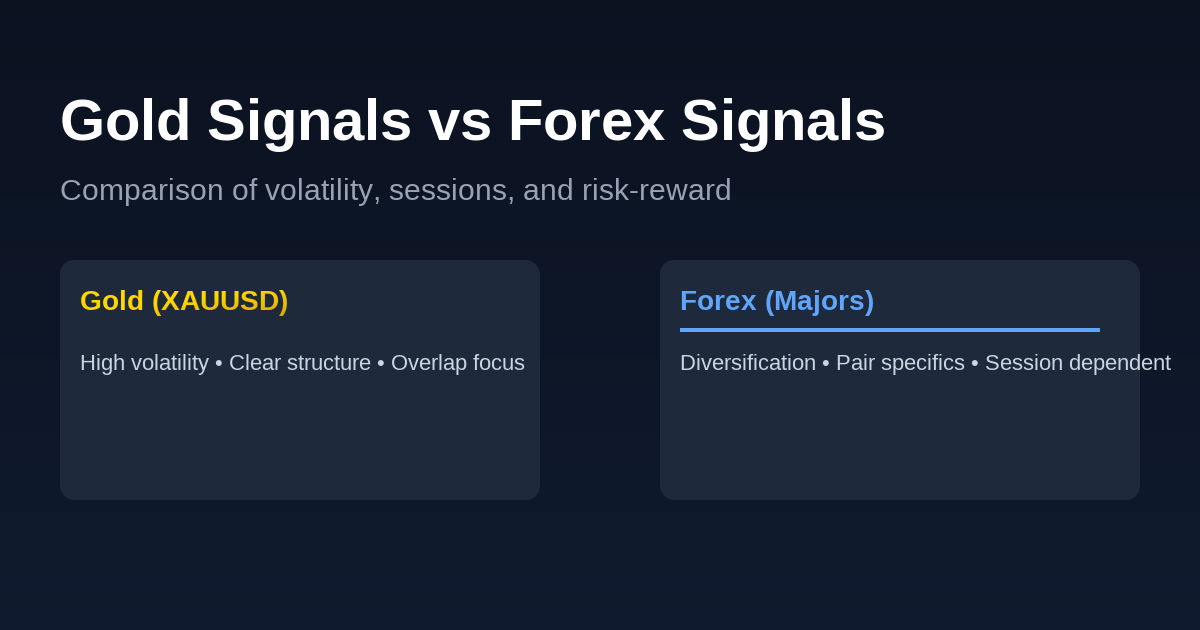
Gold signals and forex signals work the same way, with an entry, a stop loss and take-profit targets, but the markets behind them behave differently. Gold (XAUUSD) has typically moved further day to day than the major currency pairs, responds mainly to real yields, the US dollar and risk sentiment, and needs different position sizing. Neither is better in general; the right choice depends on your schedule, your account size and how much volatility you are comfortable with.
Key takeaways
- Both signal types share the same structure; the differences lie in the market, not the message.
- Gold has usually been more volatile than major pairs such as EUR/USD, so stops and targets sit further away in price terms.
- Gold is driven mainly by US real yields, the dollar and risk sentiment; currency pairs are driven largely by differences between central banks.
- Gold liquidity is deepest in the London and New York sessions, while currency pairs follow the hours of their home markets.
- Size every position from the stop-loss distance, because a gold lot and a forex lot are very different exposures.
- Compare spreads as a share of the stop distance, not in raw points.
What the two signal types have in common
A gold signal and a forex signal look almost identical. Both name the instrument, the direction, the entry, the stop loss and one or more targets, and both should come with some risk guidance. The rules for executing them are also the same: enter inside the zone, set the stop with the order, size the position from the stop, and act on management updates.
What changes is how the underlying market moves, when it is most active and what pushes it around. Those differences affect how far stops sit, when signals tend to arrive and how you should size each trade.
Side-by-side comparison
| Factor | Gold signals (XAUUSD) | Forex signals (currency pairs) |
|---|---|---|
| Instruments | One instrument: gold priced in US dollars | Many pairs, such as EUR/USD, GBP/USD, USD/JPY and AUD/USD |
| Volatility | Typically higher than the major pairs; can spike around US data | Varies widely by pair; majors are often calmer than crosses and exotics |
| Main drivers | US real yields, the dollar, risk sentiment, safe-haven demand | Interest-rate expectations and central-bank divergence, economic data, risk sentiment |
| Most active hours | London and New York sessions, especially their overlap | Depends on the pair's home markets |
| Quoting | Dollars per ounce; "pip" definitions vary by broker | Pips are standardised for most pairs |
| Contract size | Often 100 ounces per standard lot, but broker-specific | Usually 100,000 units of the base currency per standard lot |
| Spread | Wider in price terms, so compare it with the stop distance | Very tight on majors, wider on crosses and exotics |
| Concentration | Every gold signal shares one market exposure | Signals can span several economies, though many pairs share USD exposure |
Volatility
Volatility decides how far your stops and targets sit and how quickly a trade plays out. Gold has generally shown larger daily percentage moves than the most liquid currency pairs, and it can move sharply on US inflation data, jobs figures and Federal Reserve decisions. That gives gold signals room for bigger moves, but the same range applies to losses, and fast markets bring more slippage.
Major currency pairs tend to move less in percentage terms, although this is not fixed. Crosses such as GBP/JPY can be lively, and any pair can jump on a surprise rate decision. Our article on gold market volatility explains what typically moves XAUUSD and how traders adjust for it.
The practical point is that a wider stop does not mean more risk if you size correctly. A wide stop with a small position can risk exactly the same amount of money as a tight stop with a large one.
Session timing
Through most brokers, gold and the major currency pairs trade almost around the clock on weekdays, but activity is uneven.
- Gold is usually most liquid during the London session and the London–New York overlap, when major dealers are active and US data is released. The Asian session is often quieter.
- Currency pairs follow their home markets. Yen pairs often see activity in the Tokyo session, euro and sterling pairs during London hours, and US dollar pairs around New York data releases.
If you can only check your phone at certain times of day, that matters more than which market is "better". A signal you cannot act on promptly is of little use. Our guide to gold trading sessions covers the timing in detail.
What drives each market
Gold: real yields, the dollar and risk sentiment
Gold pays no interest, so its appeal tends to fall when US real yields (interest rates after inflation) rise and to improve when they fall. Because gold is priced in dollars, a stronger dollar often weighs on XAUUSD and a weaker one often supports it. Gold also attracts safe-haven demand when markets are stressed, and central-bank and investment demand can influence it over longer periods. These relationships are tendencies, not rules, and they can weaken or even reverse for long stretches.
Forex: central-bank divergence
A currency pair is the relative price of two economies' money, so the main driver is usually the gap between their interest-rate outlooks. When one central bank is expected to raise rates while another holds or cuts, the first currency often strengthens against the second. Economic data matters mostly through how it shifts those expectations. Risk sentiment plays a part too: the Japanese yen and Swiss franc have often strengthened in risk-off periods, while commodity-linked currencies such as the Australian dollar have tended to weaken.
For signal followers, this means news risk is concentrated differently. With gold, US data and Federal Reserve communication dominate. With forex, the calendar that matters depends on which pairs you trade.
Position sizing and spread differences
The method is the same; the numbers are not
Position size equals the money you are willing to risk divided by the loss one lot would suffer at the stop. The method is identical for gold and forex, but the contract specifications differ.
The example below is illustrative. Its numbers are hypothetical and chosen for easy arithmetic; they are not a recommendation, and you should check your own broker's contract specification before trading.
Account: 5,000 USD, risk 1% = 50 USD per trade

Gold (XAUUSD), contract 100 oz per lot
  Stop distance: 10.00 USD per ounce
  Loss per 1.00 lot at the stop: 10.00 x 100 = 1,000 USD
  Position size: 50 / 1,000 = 0.05 lots

EUR/USD, contract 100,000 EUR per lot
  Stop distance: 25 pips (0.0025)
  Pip value per 1.00 lot: about 10 USD
  Loss per 1.00 lot at the stop: 25 x 10 = 250 USD
  Position size: 50 / 250 = 0.20 lots
Both trades risk the same 50 dollars. Using one habitual lot size across both markets would put very different amounts at risk, which is one of the most common mistakes when traders switch between gold and forex signals. Our XAUUSD risk management guide goes into more depth.
Note also that a "pip" in gold means different things at different brokers: it may be 0.01, 0.10 or even 1.00. Pip-based performance claims for gold are therefore hard to compare.
Compare spreads against the stop
A gold spread looks large next to a EUR/USD spread in raw points, but what matters is the spread as a share of your stop distance. Continuing the illustration with hypothetical spreads:
Gold:    spread 0.30 on a 10.00 stop      = 3.0% of the risk
EUR/USD: spread 0.8 pips on a 25-pip stop = 3.2% of the risk
In this illustration the cost is similar. In real trading, spreads vary by broker, account type and time of day, and they widen around news and in thin hours. Tight stops on any instrument make the spread a larger share of the risk.
Who each suits
Gold signals may suit you if you prefer to follow one market closely, can be available during the London and New York sessions, are comfortable with faster moves, and will size every trade carefully from the stop.
Forex signals may suit you if you want exposure across several economies, need signals in other time zones, prefer the calmer major pairs, or already follow central-bank news.
Using both can work, but watch correlation. Many signals involve the US dollar, so a gold trade and several USD-pair trades can all depend on the same dollar move. Cap your total open risk, not just the risk per trade.
Whichever market you choose, our checklist on choosing a forex signals provider explains what to verify before you pay for any service.
Gold and forex signals from United Kings
United Kings, established in 2010, provides both gold (XAUUSD) and forex signals on Telegram. VIP members receive up to 10 signals a day, each with an entry, a stop loss and take-profit levels up to TP1 to TP3, plus live trade-management updates and risk-management guidance. You can observe the format in the free Telegram channel before deciding anything, and read independent member reviews on Myfxbook. More detail is on our gold signals and forex signals pages.
United Kings is a signal provider, not a broker or investment advisor, so execution, position sizing and risk remain your decisions.
FAQ
Are gold signals more accurate than forex signals?
Not inherently. Accuracy depends on the provider and its method, not on the market. Compare providers on verifiable records, the size of the average win relative to the average loss, and whether every signal has a stop loss.
Which needs more capital, gold or forex signals?
Neither has a fixed minimum, but gold's wider stops mean that even the smallest position your broker allows may risk more than 1% of a very small account. Check that you can follow signals at your chosen risk before you start.
Which is better for beginners?
Neither is automatically easier. Gold means learning one market but handling larger, faster moves; major currency pairs often move less but involve following more than one economy. Many beginners start on a demo account with a single instrument.
Can I follow gold and forex signals at the same time?
Yes, but limit your total open risk. Gold and many currency pairs are tied to the US dollar, so several open trades can add up to one large bet on the dollar.
Trading gold and forex on margin carries a high risk of loss and is not suitable for everyone. Past performance is not a guarantee of future results. This article is educational content, not financial advice.
Get United Kings gold signals
Entry, stop loss and take-profit levels on every XAUUSD signal, delivered on Telegram.
Related articles
- Gold Market Outlook: Late-2025 XAUUSD Drivers
The macro drivers that moved gold (XAUUSD) in late 2025 — inflation, rate expectations and geopolitics — and how signal traders adapted.
- Gold Trading Sessions: Best Times to Trade XAUUSD
Learn the best times to trade gold (XAUUSD): Asian, London and New York session hours in GMT, the London–New York overlap, LBMA auctions and US data times.
- Gold Volatility Explained: What Moves XAUUSD
What makes gold (XAUUSD) volatile: real yields, the US dollar, Fed decisions, CPI and NFP, geopolitics, and how to measure volatility with ATR and adjust risk.