How to Read Gold Signals: Entry, SL & Take Profit
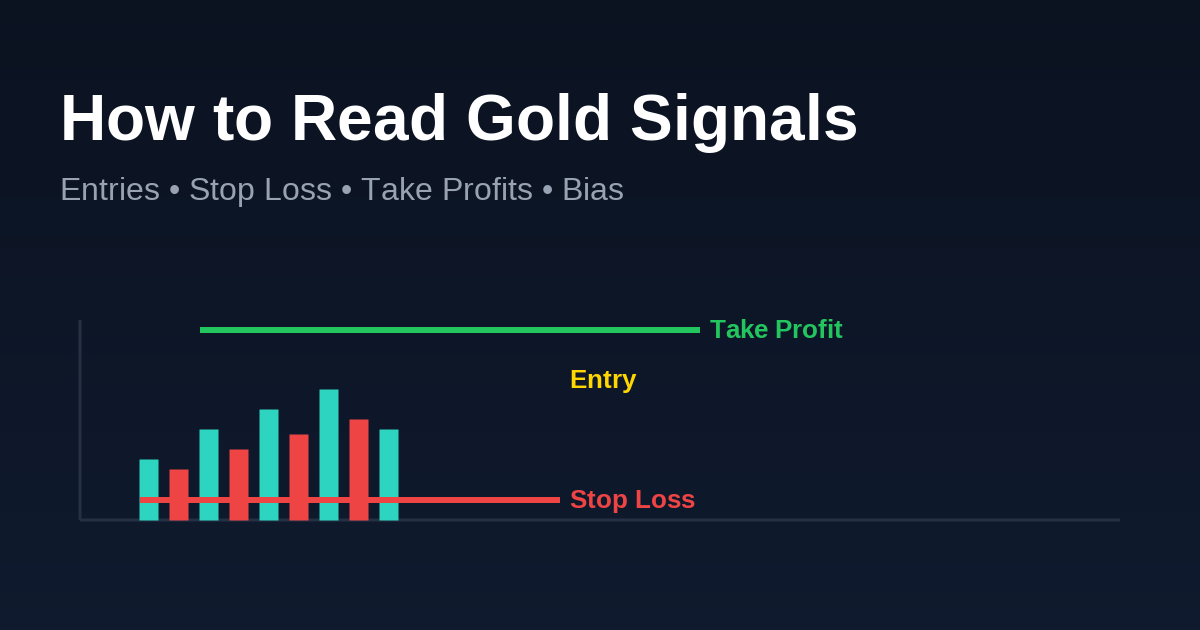
To read a gold signal, identify five things in order: the instrument (XAUUSD), the direction (buy or sell), the entry price or zone and its order type, the stop loss that caps your loss, and the take-profit targets. Before placing anything, check that the risk-to-reward still works at the price you can actually get, and size the position so the stop loss costs only a small, fixed share of your account. If any part is unclear, skip the trade.
Key takeaways
- A usable gold signal has a pair, direction, entry, stop loss and at least one take profit. No stop loss means no trade.
- A market order fills now; limit and stop orders wait for price to reach a level.
- Risk-to-reward depends on your actual fill, so late entries quietly make a trade worse.
- Spread and slippage affect when your stop loss and targets trigger, especially around news.
- Act promptly on updates such as "close partials at TP1" or "move SL to breakeven".
- Size every position from the stop-loss distance, not from a habitual lot size.
The anatomy of a gold signal
Most gold signals use the same shorthand. The prices below are hypothetical and match the worked example later on.
| Component | Example | What it tells you |
|---|---|---|
| Pair | XAUUSD | Gold priced in US dollars |
| Direction | BUY or SELL | Whether you profit from a rise or a fall |
| Entry | 2502.0–2500.0 | Where to open the trade |
| Order type | Market, limit or stop | How and when the order fills |
| Stop loss | SL 2490.0 | Where the idea is wrong and you exit |
| Take profits | TP1, TP2, TP3 | Staged exits for locking in gains |
| Notes | "Risk 1% max" | Context, risk guidance or conditions |
Pair and direction
Your broker may list XAUUSD with a suffix (such as XAUUSDm) or as GOLD, so open the exact symbol your account trades. BUY means you profit if price rises; SELL means you profit if it falls. A short reason, such as a trend continuation or a reaction from a key level, helps you judge whether the idea still holds if you see it late.
Entry price or zone
A zone such as "BUY 2502.0–2500.0" accepts that gold moves fast and prices differ slightly between brokers. Anywhere inside it is acceptable, but the closer your fill is to the stop-loss side, the better your risk-to-reward.
Market orders vs pending orders
- Market order: fills immediately at the best available price. Use it when the signal says enter now and price is inside the zone.
- Buy Limit / Sell Limit: a pending order to buy below, or sell above, the current price, used when a pullback is expected first.
- Buy Stop / Sell Stop: a pending order to buy above, or sell below, the current price, used to enter on a breakout.
If price never reaches a pending order, the trade simply does not happen, which is an acceptable outcome.
Stop loss, take profits and notes
The stop loss is the most important number in the signal: it marks where the idea is invalid and caps your loss. Enter it with the order, not afterwards. TP1 is the nearest target and usually the most likely to be reached; TP2 and TP3 are further away and less certain, so many traders close part of the position at each. Notes may add risk guidance, a news warning or a time limit, so read them every time.
A worked example signal
The signal below is illustrative. Its numbers are hypothetical round figures chosen to make the arithmetic easy; they are not a recommendation and do not reflect any current or expected gold price.
XAUUSD BUY 2502.0 - 2500.0
SL  2490.0
TP1 2510.0
TP2 2520.0
TP3 2530.0
Note: risk 1% max. Do not enter above 2502.0.
It reads as: buy gold between 2502.0 and 2500.0, with a market order if price is inside the zone now or a Buy Limit if price is above it. Exit at a loss if price falls to 2490.0. Take profit in stages at 10, 20 and 30 dollars above a 2500.0 entry. Risk no more than 1% and do not chase price above the zone.
How to calculate risk-to-reward from the levels
- Risk is entry minus stop loss for a buy, or stop loss minus entry for a sell.
- Reward is target minus entry for a buy, or entry minus target for a sell.
- Risk-to-reward is reward divided by risk, written as 1:1, 1:2 and so on.
With a fill at 2500.0 in the example, risk is 10.0. TP1 offers 10.0 of reward (1:1), TP2 offers 20.0 (1:2) and TP3 offers 30.0 (1:3).
Now suppose you enter late at 2502.0. Risk grows to 12.0 and the TP1 reward shrinks to 8.0, so TP1 is worth only about two-thirds of your risk. Two dollars of chasing weakened every target.
Brokers define a gold pip differently, so think in price distance and convert it to money using your broker's contract specification.
Execution checklist in MetaTrader 4/5 or a broker app
- Confirm the symbol exactly as your broker lists it.
- Compare price with the entry zone. If price is already beyond it or near TP1, skip the trade.
- Check the spread. An unusually wide gap between bid and ask is a reason to wait.
- Calculate your lot size from the stop-loss distance and your risk percentage.
- Choose the order type. In MetaTrader, open New Order and pick market execution or a pending order.
- Enter the stop loss and take profit before you confirm.
- Split for multiple targets. MetaTrader allows one take profit per position, so many traders open two or three smaller positions, each with its own target.
- Verify in the Trade tab that volume, stop loss and take profit are correct.
- Log the trade with the signal time, your fill and any differences.
Spread and slippage
Spread is the gap between bid and ask. In MetaTrader, buys open at the ask and close at the bid, sells open at the bid and close at the ask, and charts usually show the bid. So a sell trade's stop loss can trigger on the ask even if the bid line never touched it, especially when spreads widen.
Slippage is a fill at a different price from the one requested. It is most common in fast markets and around releases such as US jobs data, inflation figures and central-bank decisions. You cannot remove it, but you can reduce it by avoiding new entries just before scheduled news and by trading during liquid hours. Our gold trading sessions guide explains when liquidity is typically deepest.
What to do with management updates
"Close partials at TP1"
Close a portion of the position, often a third or a half. If you split the trade into separate positions, the TP1 position closes automatically; with a single position, close it with a partial volume.
"Move SL to breakeven"
Modify the position so the stop loss sits at your entry price, perhaps with a small buffer for the spread. The rest of the trade should then not lose money in normal conditions, although slippage can still cause a small loss.
"Cancel if not triggered"
Delete the pending order. The setup is no longer valid, and leaving the order open risks a fill the provider no longer supports.
"Close now"
Exit at market. This usually means conditions have changed, for example because of unexpected news.
Common mistakes when following gold signals
- Late entries. Entering away from the zone worsens risk-to-reward, as the example shows.
- Widening stops. Moving the stop further away turns a planned small loss into an unplanned large one.
- Overleveraging. Risking 5% or 10% per trade means a short losing streak can do serious damage.
- Ignoring news. Gold can move sharply on economic releases, so check a calendar before entering.
- Forcing trades. If you cannot enter inside the zone, with the stop, at your normal size, skip it.
The beginner's guide to gold signals covers these foundations step by step.
Position sizing pointer
- Choose your risk per trade, for example 1% of the account.
- Measure the stop-loss distance in price, for example 10.0.
- Find the value of a 1.0 move for one lot in your broker's contract specification. One standard lot of XAUUSD is often 100 ounces, making a 1.0 move worth 100 dollars per lot, but this varies.
- Divide the money at risk by the stop distance multiplied by that value per lot.
Illustration: a 5,000 dollar account risking 1% (50 dollars) with a 10.0 stop gives 50 divided by 1,000, or 0.05 lots. The XAUUSD risk management guide goes into more depth.
Where signals like these come from
United Kings is a gold (XAUUSD) and forex signal provider established in 2010 that delivers signals on Telegram. Its free channel has more than 300,000 members, and VIP members receive up to 10 signals a day with entry, stop loss and take-profit levels. United Kings is a signal provider, not a broker or investment advisor, so execution, sizing and risk remain your decisions. Third-party user reviews are on Myfxbook, and you can compare providers in our best gold signals guide. New to the topic? Start with what a trading signal is.
FAQ
What do TP1, TP2 and TP3 mean in a gold signal?
They are three take-profit levels at increasing distances from the entry. Traders often close part of the position at each, locking in some profit early while leaving the rest open for a larger move.
Should I enter if price has already moved past the entry zone?
Generally, no. Entering beyond the zone increases your risk and reduces your reward, so the trade no longer matches the plan. Wait for a pending level if one is given; otherwise, skip it.
Why did my stop loss trigger when the chart did not reach it?
MetaTrader charts usually show the bid, but sell positions close at the ask. If the spread widened, the ask can hit your stop while the bid stays short of it. Slippage in fast markets can also fill a stop beyond its level.
Trading gold and forex on margin carries a high level of risk and may not be suitable for everyone. Past performance does not guarantee future results. This article is educational content, not financial advice.
Get United Kings gold signals
Entry, stop loss and take-profit levels on every XAUUSD signal, delivered on Telegram.
Related articles
- XAUUSD Risk Management: Position Sizing & Stops
How to manage risk on XAUUSD trades: fixed % risk, position sizing with worked examples, stop loss placement, scaling out at TP1–TP3 and a journal routine.
- Are Gold Signals Worth It? Costs, Risks & Benefits
Are gold signals worth it? What XAUUSD signals can and cannot do, the real costs and risks, a simple break-even formula, and how to test a provider cheaply.
- Beginner’s Guide to Gold Signals (XAUUSD)
New to gold (XAUUSD) trading? What gold signals are, how they work, and how to follow United Kings signals step by step with sensible risk.