How to Choose a Forex Signals Provider (Checklist)
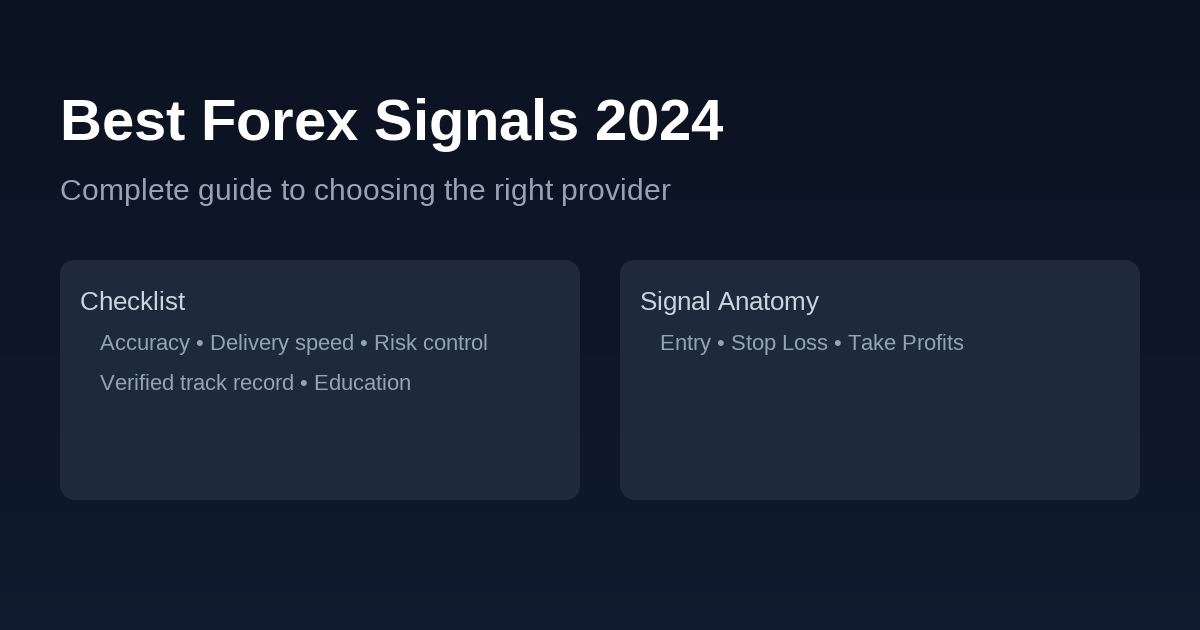
To choose a forex signals provider, judge it on what you can verify rather than on its headline win rate. A provider worth considering puts a stop loss on every signal, explains how its performance figures are calculated, has independent reviews you can read, publishes clear pricing and refund terms, and is upfront that it is a signal service rather than a broker or advisor. Test it on a free channel or a demo account before you pay anything.
Key takeaways
- Every signal should include an entry, a stop loss and at least one take profit. A missing stop loss is a deal-breaker.
- A win rate means little until you know how it is calculated and how the average loss compares with the average win.
- Read independent reviews, including the negative ones, before trusting testimonials on a provider's own channels.
- Check pricing, cancellation and refund conditions in writing before you subscribe.
- A signal provider should never ask for your trading password or hold your funds.
- Test for free first: observe a free channel, then paper-trade the signals on a demo account.
What a forex signal should contain
A forex signal is a trade idea that someone else has prepared and that you decide whether to execute. If the concept is new to you, our guide to what a trading signal is covers the basics. A complete signal includes:
- Instrument and direction: for example, EUR/USD buy or XAUUSD sell.
- Entry price or zone: where to open the trade, and whether to use a market or pending order.
- Stop loss: the price at which the idea is wrong and you exit with a planned, limited loss.
- Take profit: one or more targets, often labelled TP1, TP2 and TP3.
- Notes and risk guidance: context such as a news warning, a suggested maximum risk, or a condition for cancelling the trade.
- Follow-up updates: messages telling you to take partial profit, move the stop, or close early.
A signal without a stop loss is not a complete trade plan, because it leaves the size of your potential loss undefined.
The provider checklist
Use this table when comparing providers. None of these checks requires you to pay first.
| What to check | Why it matters | Red flag |
|---|---|---|
| Stop loss on every signal | It defines your maximum loss before you enter | Stops "sent later", or no stops at all |
| How results are calculated | A win rate can be flattered by counting tiny wins or leaving losers open | No explanation of what counts as a win or a loss |
| Independent reviews | Third-party reviews are harder to curate than testimonials | Only screenshots and testimonials on the provider's own channels |
| Realistic claims | Real trading includes losing streaks and drawdowns | Promised profits, "no losses", or fixed monthly returns |
| Pricing and cancellation | You should know exactly what you pay and how to stop | Hidden renewals, vague prices, or "message us for the price" |
| Refund terms | Tells you what happens if the service does not suit you | No written refund policy, or conditions you cannot find |
| Regulatory status | Signal providers, brokers and investment advisors are different things | Claims of regulation you cannot verify, or deliberately vague wording |
| Handling of funds | A signal service has no reason to touch your money | Requests to deposit with them, or for your account login |
| Delivery and timing | Signals only help if you can act on them in time | Signals routinely posted after price has already moved |
| Support | You will need answers about billing and access | No named contact, or support that disappears after payment |
Red flags that should end your evaluation
Some warning signs matter more than others. Walk away if a provider:
- Promises profits or a fixed return.
- Sends signals without stop losses, or tells you stops are unnecessary.
- Asks for your broker login, offers to "manage" your account, or asks you to send money anywhere other than a clear subscription checkout.
- Deletes or edits losing signals after the fact.
- Uses countdown timers, "last three spots" messages or other pressure to make you pay quickly.
- Offers to "recover" your previous losses for an extra fee.
- Pushes a particular broker without explaining why, or what the relationship is.
How to verify a provider step by step
- Observe before paying. Join the provider's free channel, if it has one, and record every signal for a few weeks: entry, stop, targets and outcome. Include the losers.
- Read independent reviews. Look for third-party platforms where members post their own experiences. Read the negative reviews and check whether complaints follow a pattern, such as billing or access problems.
- Confirm the stop-loss habit. Every signal you recorded should have had a stop loss at the moment it was posted.
- Ask how performance is measured. Does the win rate count only closed signals? Is a trade that hits TP1 and then the stop counted as a win? How far is the typical stop compared with the targets?
- Read the terms. Find the price, billing period, cancellation process and refund window in writing, and note any conditions attached to a refund.
- Check what the provider actually is. A signal provider is normally not a broker or an investment advisor. If a provider claims to be regulated, check the claim on the regulator's own public register rather than trusting a logo.
- Paper-trade on a demo account. Execute the signals on a demo account as you would live, including the delay between the alert and your entry. This shows what you would really have achieved, which can differ from the provider's figures.
- Start small. If you go live, keep your risk per trade low until your own results confirm what you saw on demo.
Why a win rate alone can mislead
A win rate is the share of closed trades that ended in profit. It says nothing about how large those wins and losses were. A provider that wins often with small targets, and occasionally loses with a wide stop, can show an impressive win rate and still lose money overall. The opposite also holds: a method with a modest win rate can be profitable if its average win is much larger than its average loss.
When you assess any performance figure, ask for three things together: the win rate, the average reward compared with the average risk, and the number of trades the figure is based on. A large sample across different market conditions tells you far more than one good month. Remember too that your own results will differ from a provider's because of entry timing, spreads, slippage and position sizing.
Making signals work once you choose
Even a well-run service only gives you trade ideas. Your results depend on how you act on them.
- Size from the stop. Decide a fixed risk per trade, commonly 1% of the account or less, and calculate the lot size from the stop-loss distance. The XAUUSD risk management guide walks through the arithmetic, and the same method works for currency pairs.
- Enter inside the zone or skip. Chasing price after it has moved past the entry weakens the risk-to-reward of every target.
- Never widen the stop. Moving the stop further away turns a planned small loss into an unplanned large one.
- Act on updates promptly. Partial-profit and breakeven instructions are part of the plan.
- Expect losing streaks. Size small enough that several losses in a row do not change your behaviour.
- Keep a journal. Record each signal, your fill and the result, so you can compare your execution with the provider's record.
If you are weighing whether a subscription can pay for itself at your account size, the break-even framework in are gold signals worth it applies to forex signals too.
How United Kings fits these criteria
TopGoldSignals.com is the official United Kings gold signals site, so this section is a provider describing itself. We have kept it to facts you can check, and the verification steps above apply to us as much as to anyone else.
United Kings is a gold (XAUUSD) and forex signal provider established in 2010, with signals delivered on Telegram.
| Checklist item | United Kings |
|---|---|
| Stop loss on every signal | Each VIP signal includes an entry, a stop loss and take-profit levels, up to TP1 to TP3 |
| Follow-up | Live trade-management updates and risk-management guidance |
| Free way to observe | A free Telegram channel with more than 300,000 members |
| Independent reviews | Member reviews on Myfxbook |
| Performance claim | United Kings reports a historical win rate of about 85% on closed VIP signals. This is its own figure; losing trades happen, and past performance does not guarantee future results |
| Pricing | $199 a month, cancel anytime, or $499 one-time for lifetime access (regular price $999), paid on unitedkings.net |
| Refunds | A 48-hour refund window; conditions apply, so read them before paying |
| Status | A trading signal provider, not a broker or investment advisor; it never holds client funds |
| Scale | More than 13,000 VIP traders in over 50 countries |
| Support | Priority support for VIP members; contact @uktyler on Telegram |
For a fuller assessment, including limitations, read our United Kings gold signals review. You can compare plans on the pricing page or see how the service covers currency pairs on our forex signals page.
FAQ
Are paid forex signals worth it?
It depends on your account size, costs and execution, and nobody can know in advance. A subscription has to be covered by your net trading results after spreads and slippage, which is harder on a small account. Test on a free channel and a demo account first.
Can beginners use forex signals?
Yes, if they learn what each part of a signal means, use a small fixed risk per trade, and treat signals as a way to learn rather than as a source of reliable income. Practising on a demo account first is sensible.
How can I tell if a signals provider is legitimate?
Look for stop losses on every signal, independent reviews, clear written pricing and refund terms, and honesty about what the provider is. Be wary of promised returns and of anyone who asks for your account login or your funds.
Should I use more than one signal provider?
It is usually better to start with one. Several providers can send conflicting trades on the same pair, which makes it hard to control your total risk and to judge which service is actually helping.
Trading forex and gold on margin carries a high risk of loss and is not suitable for everyone. Past performance is not a guarantee of future results. This article is educational content, not financial advice.
Get United Kings gold signals
Entry, stop loss and take-profit levels on every XAUUSD signal, delivered on Telegram.
Related articles
- What Is a Trading Signal? A Plain-English Guide
Learn what a trading signal is, who creates signals, what each part means, free vs paid options, how to vet a provider honestly, and how to start safely.
- Beginner’s Guide to Gold Signals (XAUUSD)
New to gold (XAUUSD) trading? What gold signals are, how they work, and how to follow United Kings signals step by step with sensible risk.
- United Kings Gold Signals Review (2026)
United Kings gold signals review for 2026: what VIP includes, signal format, Telegram delivery, pricing, refund window, pros, limitations and who it suits.